
Alumni
Paty Baum
Documentary filmmaker (at MLC 1971-73)
MY PARENTS wanted me to go to MLC, so I transferred there in 1971 from Fernwood Elementary School, in my 8th grade year. I was the first one from my family to attend; my sister Connie (two years older than me) and my brother Chris (two years younger) followed shortly. Throughout my first year (we lived in Irvington), I got a ride to school with Vern Rutsala, who drove his son Matthew (a linguistic genius who strolled the halls unapproachably lost in thought) in their ancient, '50s Plymouth, a whale of a car. Poet Rutsala and my dad taught at Lewis and Clark College together, and he may have been the one who told my parents about MLC. Once my siblings joined me, we caught the Number 5 (Broadway) Rose City Transit bus on NE 24th and Thompson every morning with Charles Barton, transferring downtown on SW Washington to the Number 2 (Glisan) that dropped us in front of the school. Our arrival contrasted with the fleet of VW vans that dropped off (and picked up) the Willamette Heights kids every day.
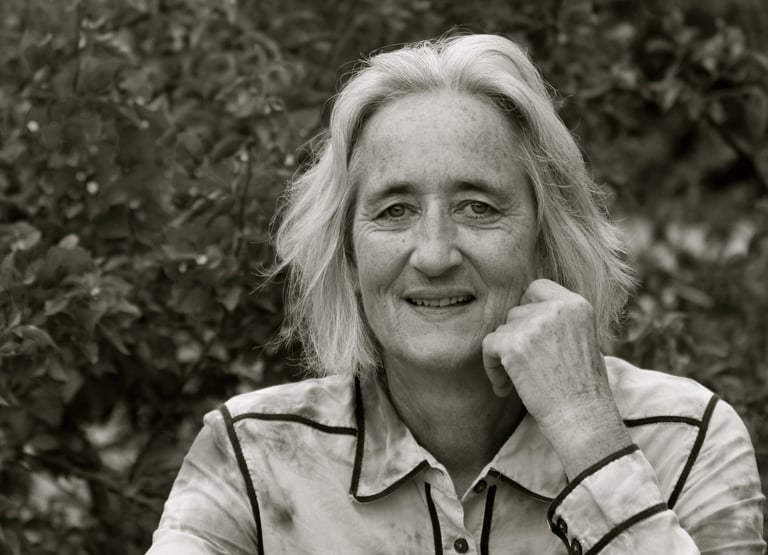
Paty Baum
Paty told her story in April 2026:
It was great to have my sister and brother at MLC, and I did my best to orient them. Chris quickly became very popular because he played the piano and sang, and soon formed a band with Gary Fountaine and Mark Borden. Chris Miller came to MLC a little later and teamed up with them; (Fast) Eddie Fountaine and Chris Mayther often jammed with them.
At first, I didn't really know anyone except the families (Taylors, Daggetts and Galahers) who had been with us at Riverdale School. Initially, I hung out in Ehrick Wheeler's room where I found a relatively calm, welcoming environment. My favorite part of Base Station was the reading (by Ehrick), of the day’s highlights from a mimeographed sheet. It might include field trips, visiting artists or writers who’d come to do fun projects with us, educators and academics wanting to study us, or a news crew hoping to do a story about the free-for-all that (according to the straight press) was posing as public education. After the first week, I found friends and became a member of the MLC tribe. I got in with the smokers who hung out in “the hole” in Couch Park. We started the day with a cigarette and maybe something from the quickie mart. We shot the shit for about an hour; topics included who’d gotten busted or ripped off, wild parties, keggers in the Meadow, plans for lunch or a possible outing, weekend shenanigans (we were from different Portland neighborhoods), and what was happening at school that day. Then we went back into school and went our separate ways, to whatever activity looked fun or challenging, and met up again at lunch time.
Looking back on my time, at how the MLC experience influenced my 13-year-old self, I remember I worshipped the HS students. I thought they were so cool even if many seemed stoned, aimless, and generally lacking focus. They all dressed in costume and carried props as if from a theatrical production: acoustic guitar, long baggy coat, suede vest, filthy patched jeans, boots, Mexican-woven shoulder bag. They drifted in and out of the school as if it were a place they only occasionally needed to visit. One afternoon, I met an unnamed HS student by the basement entrance near B1; unlike the others he was a very natty dresser. He bragged that he’d just stolen an expensive 10-speed bicycle and was going to strip it down and repaint it in the shop. He assumed I was on board, in awe of his boldness. I was not impressed; my own 10-speed bicycle had recently been stolen.
B1 soon became my preferred room, due to the outpouring of creativity that flowed from the walls. Students of all ages were engaged in drawing, painting, papier mache, mask making, ceramics, filmmaking, comics and music. Betty Mayther never judged anyone; all were welcome there, dirty, tired, hungry, soaking wet or stoned. It could get crowded in there; the tables and chairs were primary school size, so it looked like we really were at play. I did a lot of ceramics, and aspired to be as good as Marlys Mick, who was a very skilled potter and had even mastered the unpredictable glazes. A high moment was making a traditional Japanese tea set, which culminated with an outdoor raku firing that sent flames shooting up above the windows.
I close my eyes and see a table full of boys collectively drawing a comic, another group on the floor painting abstractly on a piece of large newsprint, a Super 8 camera set up and pointed at a clay figure being manipulated for animation, a messy wheat paste project, a group doing creative writing with Manny Bernstein, someone barefoot in the bathtub kneading the clay, and another person throwing a pot on the kick wheel. In the background Betty Mayther watches over her brood like a mother hen, with minimal intervention and total respect for the individual. The fact that there were also 10 other classrooms that had amazing teachers, aides and volunteers working with students on a variety of science, literacy, creative writing, design, math, computer, photography, sewing, cooking, calligraphy, music, theatre, and other projects, made it like an educational circus, never a dull moment, and something for every inquisitive mind and learning style.
By choice, I left after two years to attend John Adams HS. I was spending too much time in the park and even at that age, knew I would be better off in a more structured setting. I credit my resourcefulness, lifelong learning capacity and love of the outdoors to my brief time at MLC, where anything and everything was possible. After that, I wholeheartedly pursued my interests in photography and music, shooting photos and playing drums in the all-woman punk band Neo Boys (with MLC alumna Kimberly Kincaid). After jumping through many hoops, I was finally given a show on KBOO Community Radio. I eventually became a sound recordist and worked on Gus Van Sant's independent production, Mala Noche.
In 1989, I was accepted into San Francisco State University's film production program and went on to make my own films: 122 Webster (1990), The Cleansing Machine (1991), and Peace, Love, '92 (1992). The latter two were shot in Portland with non-professional actors. I moved to Baja Sur, Mexico, in 1995, to surf and enjoy 355 days of sunshine, but I’ve always kept in touch with my MLC classmates.
In 2003 I decided to do some interviews with MLC teachers and students, and was lucky enough to interview Amasa Gilman, Emil Abramovic, Betty Mayther, John Morrison, Chris and Craig Mayther, Carol Bialostosky, Gary Fountaine, Jeana Edelman, Sarah Berry, and others. These interviews were edited into the documentary MLC, The Early Years, and I still have them in their unedited form. In 2018 I did more interviews, and put a fly-on-the-wall video camera at the main entrance to the 50th Anniversary gathering.
I believe that anyone who attended or worked at MLC has a compelling story to tell about their experience. MLC'ers are a tribe of unique individuals who are bound by the philosophy that we know what we want and are capable of (self) realizing our wishes and dreams.
[Paty's on-camera interviews with nine MLC students attending the 2018 50th Anniversary celebration, as well as three of the 2003 interviews she used in her documentary MLC: The Early Years, can be viewed via the links—as can footage from the wall-mounted camera Paty helped arrange and set up at the 50th]